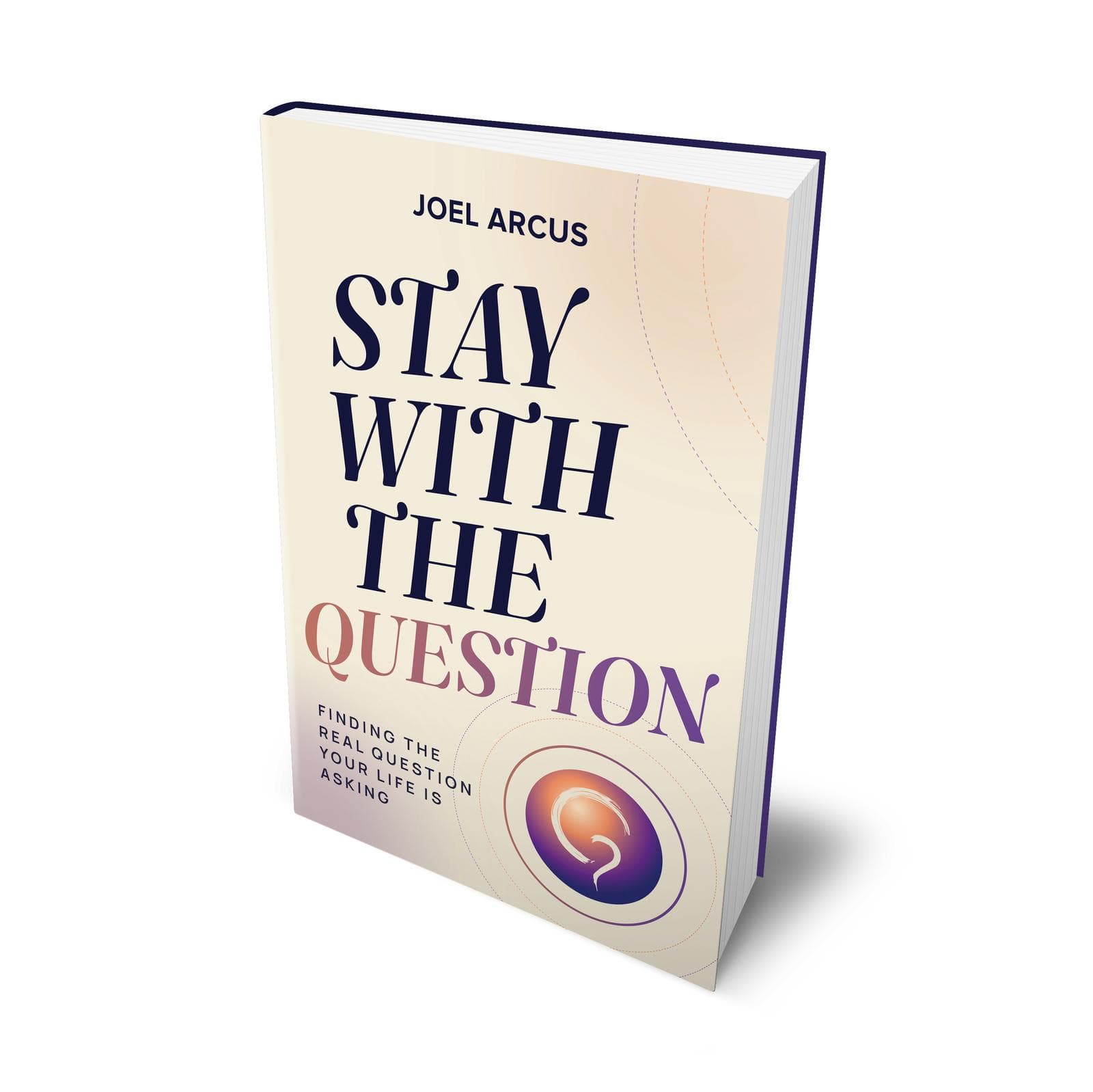
Launching September 2026

Stay With the Question

We do not live our lives on the days when everything is decided. We live them on Tuesdays.

We are trained, almost from birth, to answer questions as quickly as we can. Speed is rewarded. Certainty is mistaken for competence. And so when something in our lives genuinely matters — a decision, a direction, a quiet sense that the life we are living is not quite the one we meant to — we do the only thing we have been taught to do. We reach for an answer.

This is a book about doing the opposite.

It is about learning to hold a real question long enough that it can show you something the fast answer never could. About the difference between the problem you arrived with and the question waiting underneath it. And about the strange, settled clarity that becomes available when you stop trying to resolve the question, and simply stay with it.

Read the opening

The moment he walked into the room I could tell this was not a problem about information.

You may recognise something in this before the story is done. Not the specifics, not the job or the decision or the years in the role. Something in the quality of it. The particular kind of stuck that comes not from lack of thinking but from an excess of it. The exhaustion of having been genuinely thorough with yourself and still not arrived anywhere that holds. If that resonates, it is already pointing you somewhere. Hold it lightly and keep reading.

He set two careful stacks of paper on the table between us. Spreadsheets. Scenarios. Pros weighed against cons that had changed places so many times the balance had started to feel like choreography. He was a decisive man. The kind of person other people brought their hard problems to, and he knew it, had built a quiet confidence around knowing it, and now that confidence had nowhere useful to go. He had been circling the same decision for months. Stay in the role or leave. Every time he got close to an answer it dissolved. Every time he thought he understood what he wanted, the other side of the argument assembled itself with equal conviction.

"I need to decide," he said. "I've been doing this for months and I'm no closer than the day I started."

He had argued both sides so convincingly that the argument had become the trap. In rooms full of people he could carry the case either way. Alone at three in the morning he could not carry it at all. He told me what the board thought. He told me what his family hoped. He told me what his younger self would have envied and what his older self feared. The words came quickly, efficiently, like a man who has rehearsed a presentation so many times he no longer hears it.

"Which way should I swim," he said. "You're the coach. Tell me."

I asked him to turn the first page of his stack face down.

He did. We sat in a silence that lasted long enough to become useful. Rooms have a way of going quiet in the moments before someone tells the truth. You can feel it if you do not rush to fill the space. When the quiet had changed quality, I pulled a legal pad between us and wrote a single sentence at the top.

It was not clever. It was not original.

But it was alive in a way that his question was not.

Ten years from now, what do you want an average Tuesday to feel like.

He looked at the words as if they had arrived from a friend he had not seen in a long time. "Tuesday," he repeated, a little amused. I nodded. We do not live our lives on vacations or milestone announcements or the days when everything is decided. We live them on Tuesdays. On the ordinary, unremarkable texture of a working morning. On the inbox at eight o'clock and the first hour and whether the work in front of us asks something real of us or simply asks us to continue.

He smiled, reflex first and then something slower and more honest, and he started to write.

At first the pencil moved as carefully as his speech. Then it picked up speed, as if his hand had outrun the part of his mind that edits before it knows what it wants to say. He wrote about mornings that did not begin with dread. He wrote about work that felt worth doing when nobody was watching. When he stopped, the neat stacks of analysis were still on the table. But they had lost their gravity. Something had entered the room that had not been there before.

A different question had entered the room.

You probably have a question of your own somewhere close to the surface right now.

The Introduction continues in the book.

Join the list to read the rest first

The book arrives September 2026. Be the first to read it. See our Privacy Policy.

Book a session — $540 $79