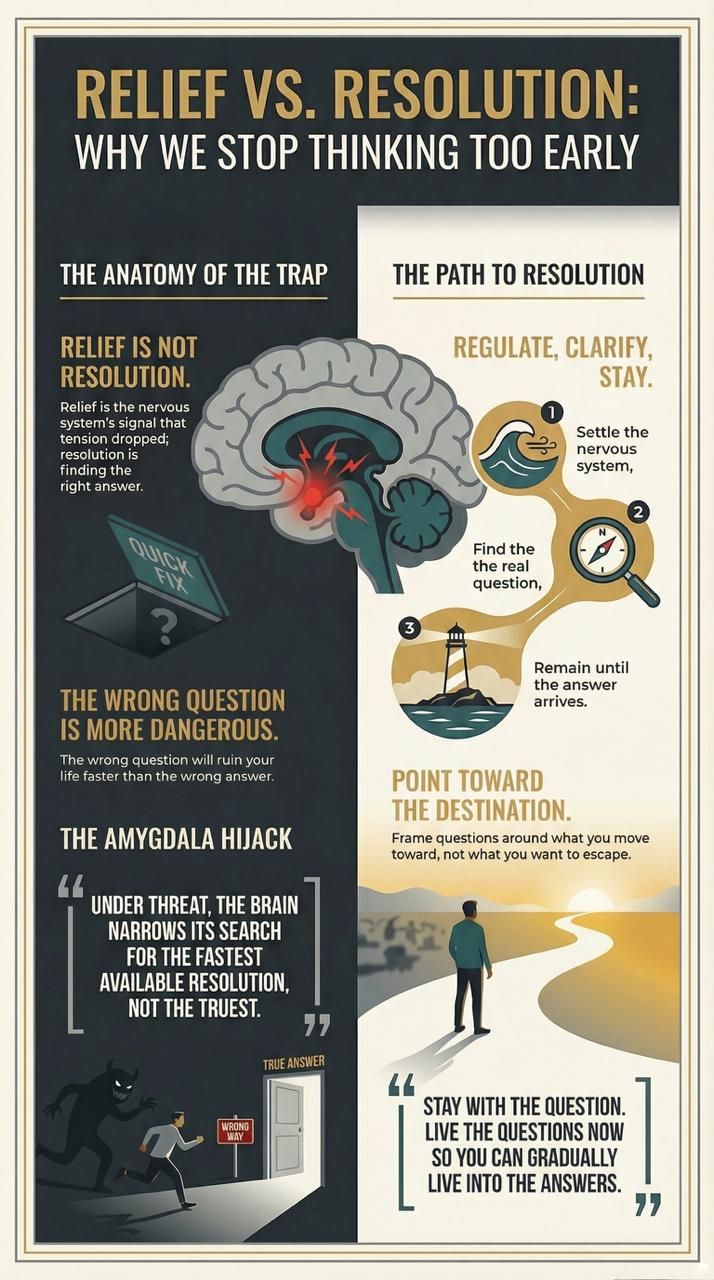
So, what can we take away from all of this? Good decisions often feel worse at first
If relief and resolution feel the same in the moment, it creates an interesting problem.
The decisions that bring immediate relief are not always the decisions that lead to good outcomes. And the decisions that lead to good outcomes often do not bring immediate relief.
Sometimes the right decision makes things more uncomfortable in the short term. It requires a difficult conversation, a period of uncertainty, more responsibility, more risk, more patience, or admitting something you would rather avoid.
So if you start using relief as a way to measure whether a decision was good, you slowly train yourself to make decisions that reduce discomfort, not decisions that solve problems.
Over time, this can look like there is always movement and always decisions being made. But many of those decisions were made to end uncertainty, not to move in the right direction.
So one of the more difficult skills in decision-making is learning that sometimes the right decision does not feel good when you make it.
And sometimes the decision that feels the best in the moment solves the least. My take on it: find the right question rather than immediately trying to make the decision.
I have since written the full version of this distinction: The difference between relief and resolution