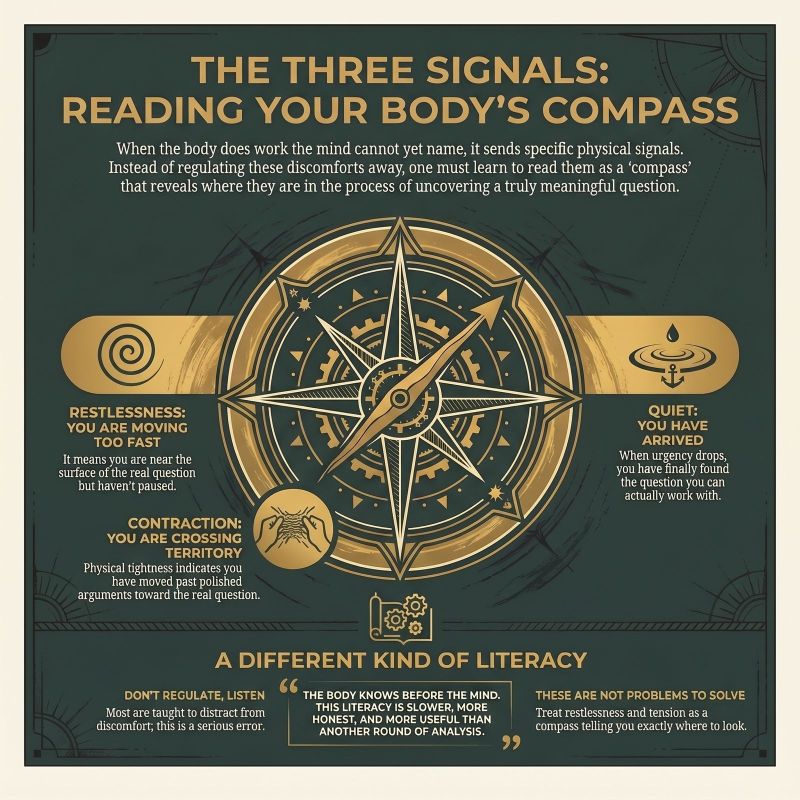
If the body is doing work the mind cannot yet name, you need to know how to read it.
After hundreds of coaching conversations, I have come to trust three signals. Not as symptoms to manage, but as signatures that tell you where you are in the work of a question.
Restlessness. Something is asking to be looked at, and you are still moving too fast to see it. Restlessness almost always means you are close to the surface of the real question but have not yet let yourself pause long enough to hear it.
Contraction. A tightening in the chest, throat, stomach or shoulders. Contraction shows up when you are closer to the real question than the surface one. The mind may still be producing polished arguments. The body is telling you it has already crossed into different territory.
Quiet. This is the one most people misread. They assume quiet means nothing is happening. It almost always means the opposite. When the nervous system settles, when the urgency drops, when the question stops feeling like pressure, you have usually arrived. Not at an answer. At the question you can actually work with.
Most of us are taught to regulate these signals away. Calm the restlessness. Release the tension. Distract the discomfort. That is a serious error.
These are not problems to solve. They are the compass. Learning to read them is a different kind of literacy. Slower. More honest. More useful than another round of analysis. If the question you are carrying has been producing restlessness for weeks, you are not stuck. You are being told where to look.
hashtag#StayWithTheQuestion hashtag#Leadership hashtag#Coaching hashtag#EmotionalIntelligence